Skip to the workshop explorer

The consolidated report

Advancing
Target 3

A shared learning journey
toward 30x30.

What 12 regional and subregional workshops reveal about turning global ambition into practical action.

Explore the workshops Read the shared findings
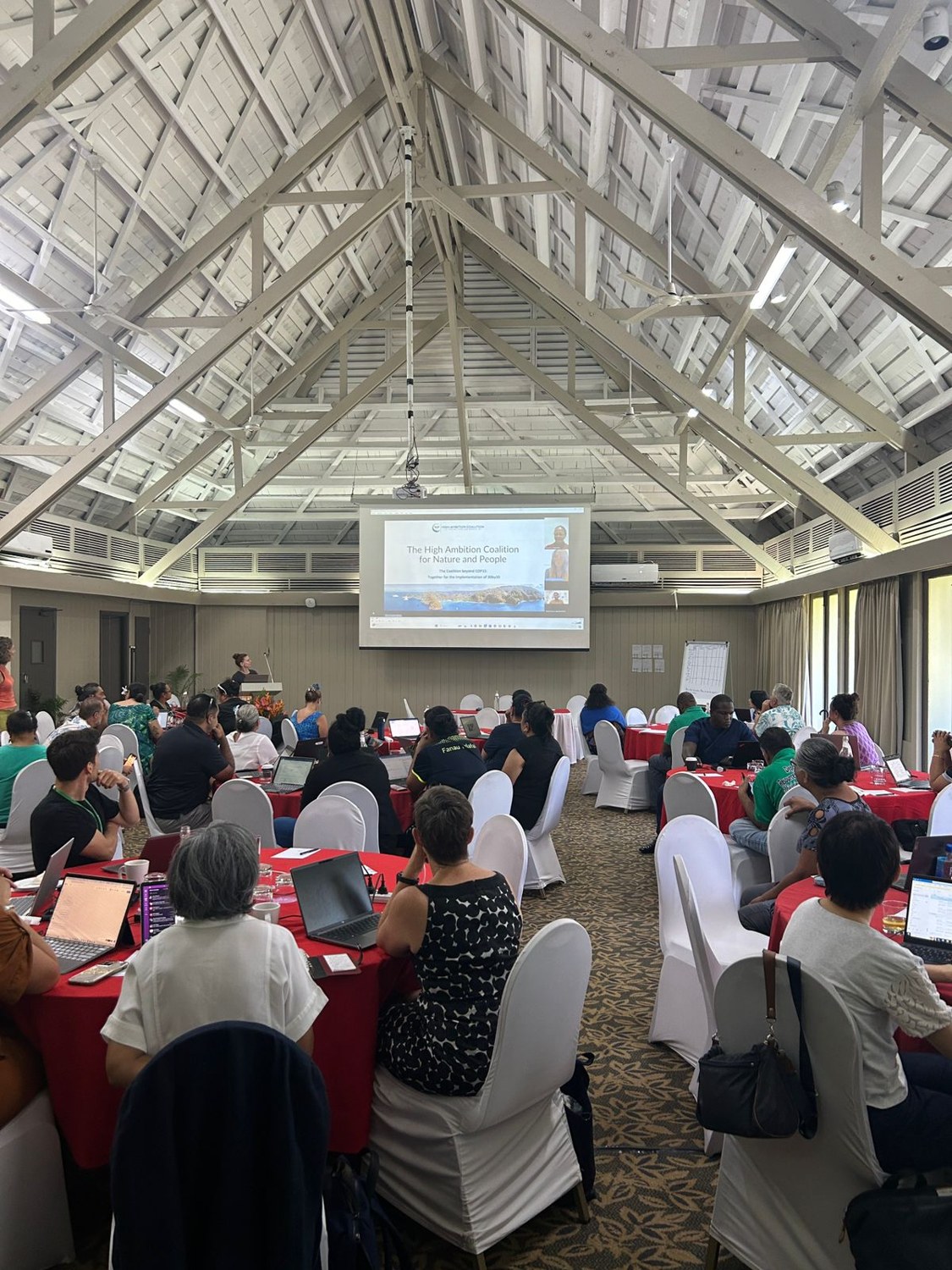
Participants gathered in a timber-roofed venue during the Pacific workshop in 2024.
Learning from each otherPacific workshop · 2024
Workshops
12
Distinct countries
121
Participants
709
Host locations
11

Cumulative reach of the 2024–2026 workshop series. Each country is counted once in the distinct-country total.

Browse participating countries and territories ↗

01 / The journey

Countries are not
starting from zero.

Across regions, countries are already advancing protected areas, OECMs, and customary and community-led conservation.

Between 2024 and 2026, the workshops created space to share that experience, examine implementation barriers and identify practical priorities for Target 3 of the Kunming-Montreal Global Biodiversity Framework.

The discussions addressed both conservation coverage and quality: ecological representativeness, connectivity, management effectiveness, equity and governance.

How the series came together

The first workshop took place in Abuja in February 2024. What began as separate opportunities evolved into a broader partnership, with formats and partners adapting to regional needs.

The series included seven subregional capacity-building workshops convened by the CBD Secretariat with partners. HAC for Nature and People co-organized 11 of the 12 workshops.

01

Share progress

Compare practical experience and working models.

02

Surface challenges

Identify shared barriers and context-specific needs.

03

Learn from peers

Exchange tools, approaches and lessons across regions.

04

Inform action

Develop priorities and practical follow-up pathways.

2024

Build a shared language

Compare starting points, clarify Target 3 quality and surface regional barriers.

2025

Deepen regional delivery

Sharpen policy, finance, rights, management and cooperation priorities.

2026

Connect dialogue with follow-through

Link workshop priorities with practical requests, peer exchange and partners.

02 / Regional priorities

One journey.
Different contexts.

Select a location or workshop to explore the implementation priorities participants identified.

Workshop host locations, shown approximately. Nadi hosted two workshops.

Workshop location Selected workshop

Workshop 01 / 12 2024

West Africa

Abuja, Nigeria
19-22 February 2024

Planning, capacity and protected-area expansion

Aligning spatial planning, NBSAPs and ECOWAS action can accelerate delivery. Participants also stressed stronger management systems, finance and local-community engagement.

PlanningManagementFinance
Core organizing partners

HAC; Nigeria; Côte d’Ivoire

Workshop 02 / 12 2024

Pacific

Nadi, Fiji
22-23 March 2024

Customary stewardship, monitoring and connectivity

Dispersed islands need durable monitoring and community-led conservation across seascapes. Customary stewardship and culturally important areas remain central to practical implementation.

Customary stewardshipMonitoringConnectivity
Core organizing partners

CBD Secretariat; UNEP

Also in Nadi: the 2026 workshop

Workshop 03 / 12 2024

Caribbean

Georgetown, Guyana
16-19 April 2024

Management effectiveness and OECM pathways

Stronger existing systems can turn designation into outcomes and regional coherence. Finance, OECM knowledge and local enforcement were identified as immediate needs.

ManagementOECMsFinance
Core organizing partners

CBD Secretariat; HAC; CARICOM Secretariat

Workshop 04 / 12 2024

Central Africa

Kinshasa, DR Congo
3-5 June 2024

OECM clarity and practical guidance

Shared working methods can turn limited understanding into national recognition pathways. Practical guidance and a regional working group could sustain technical follow-through.

OECMsGuidanceRegional cooperation
Core organizing partners

HAC; Gabon; France; WCS

Workshop 05 / 12 2024

Latin America

Puntarenas, Costa Rica
9-13 June 2024

Diverse conservation pathways and regional collaboration

OECMs, IPLC inclusion and regional networks can expand durable conservation options. Participants emphasized resources, cross-border exchange and stronger experience-sharing through RedParques.

OECMsInclusionRegional networks
Core organizing partners

CBD Secretariat; HAC; Costa Rica; UNEP; WWF

Workshop 06 / 12 2024

South Asia

Kathmandu, Nepal
29 July-1 August 2024

Connectivity, representation, rights and reporting

Corridors and inclusive governance connect ecological integrity with credible national reporting. Context-adapted OECM pathways and better databases were also recurring priorities.

ConnectivityRightsReporting
Core organizing partners

CBD Secretariat; HAC; ICIMOD

Workshop 07 / 12 2024

Pacific

Sydney, Australia
8-11 October 2024

Ocean governance and peer exchange

Focused exchange helps translate stewardship experience across national and ocean-scale systems. Australia, Palau and Niue compared governance approaches, Indigenous stewardship and marine connectivity.

Ocean governanceIndigenous stewardshipPeer exchange
Core organizing partners

HAC; Australia; SPREP

Workshop 08 / 12 2025

Central, Southern and Eastern Africa

Nairobi, Kenya
16-20 February 2025

Policy guidance, rights, OECMs and cooperation

National frameworks and transboundary cooperation can connect rights with long-term delivery. Participants emphasized OECMs, traditional knowledge and Target 3 integration into national policy.

PolicyRightsOECMs
Core organizing partners

CBD Secretariat; HAC; IUCN regional office; NatureXpairs; WCPA; AWF

Workshop 09 / 12 2025

Mediterranean

Montpellier, France
2-5 June 2025

Policy coherence, finance and delivery

Regional frameworks need political commitment and resources for consistent implementation. Governance, policy coherence and management effectiveness were linked to sustained delivery.

Policy coherenceFinanceManagement
Core organizing partners

HAC; IUCN regional office; NatureXpairs; France; UNEP

Workshop 10 / 12 2025

Southeast Asia

Bangkok, Thailand
17-20 June 2025

Effective management, reporting, finance and inclusion

Harmonized systems and safeguards can improve effectiveness and widen access to support. Reporting, finance, transboundary cooperation and inclusion of IPLCs, women and youth were interconnected.

ReportingFinanceInclusion
Core organizing partners

CBD Secretariat; HAC; IUCN regional office; NatureXpairs; ACB

Workshop 11 / 12 2026

Central Asia

Tashkent, Uzbekistan
3-6 February 2026

Institutionalizing OECM pathways

Clear legal criteria, adapted guidance and sustained finance can move recognition into practice. Translation, management-effectiveness systems and national budget allocations were practical next steps.

OECM pathwaysGuidanceFinance
Core organizing partners

CBD Secretariat; HAC; IUCN regional office; NatureXpairs

Workshop 12 / 12 2026

Pacific

Nadi, Fiji
9-11 June 2026

Finance, human capacity and policy coherence

Linking these pillars turns dialogue into actionable requests and regional follow-through. Country teams used matchmaking and partner channels to develop concrete follow-up needs.

FinanceHuman capacityPolicy coherence
Core organizing partners

HAC; Australia; SPREP

Also in Nadi: the 2024 workshop

These snapshots reflect workshop discussions and priorities. They do not rank regions or represent formally adopted national commitments.

03 / Shared findings

Eight conditions
for lasting outcomes.

Policy, finance, people and governance need to advance together.

The report groups recurring workshop messages into eight enabling conditions. Each appeared in different combinations across regional contexts.

Explore each condition, then follow a regional example to see how it took shape in practice.

01Policy and legal coherence

Updated laws, clear pathways and joined-up planning.

Participants linked Target 3 to national policies, NBSAPs, spatial planning and regional frameworks. Clear responsibilities and coordination across sectors help translate priorities into implementation.

Explore a regional example: West Africa
02Sustainable finance

Long-term financing that sustains implementation.

Short-term resources limit the durability of conservation efforts. Workshop priorities included predictable finance, national budget allocations and resources for effective management.

Explore a regional example: Mediterranean
03Human and technical capacity

People, skills, equipment and institutional support.

Practical guidance depends on people and institutions able to apply it. Participants identified a need for training, accessible tools, adapted guidance and sustained support.

Explore a regional example: Pacific, 2026
04Management effectiveness

Protected and conserved areas that work in practice.

Designation needs to translate into effective and equitable conservation. Participants stressed stronger management systems, assessment tools and the resources needed to sustain outcomes.

Explore a regional example: Caribbean
05OECM recognition

Context-specific pathways to identify and report OECMs.

Other effective area-based conservation measures (OECMs) require clear criteria and guidance adapted to national circumstances. Regional learning can help countries move from understanding the concept to recognition in practice.

Explore a regional example: Central Asia
06Connectivity and cooperation

Ecological corridors and transboundary collaboration.

Countries highlighted connections across landscapes and seascapes, alongside regional and cross-border cooperation. Peer networks provide a way to share practical experience across these settings.

Explore a regional example: South Asia
07Data, monitoring and reporting

Trusted information systems that support decisions.

Fragmented data and uneven monitoring capacity make implementation harder to assess. Priorities included stronger databases, monitoring systems and credible national reporting.

Explore a regional example: Pacific, 2024
08Rights, equity and inclusion

Governance with Indigenous Peoples, communities, women and youth.

Participants emphasized meaningful roles for rights-holders, recognition of customary stewardship and traditional knowledge, and inclusive governance. These priorities connect conservation quality with how decisions are made.

Explore a regional example: Southeast Asia

From workshop to follow-through

Keep the exchange going.

Regional partners describe how workshop priorities can connect with practical support and further collaboration.

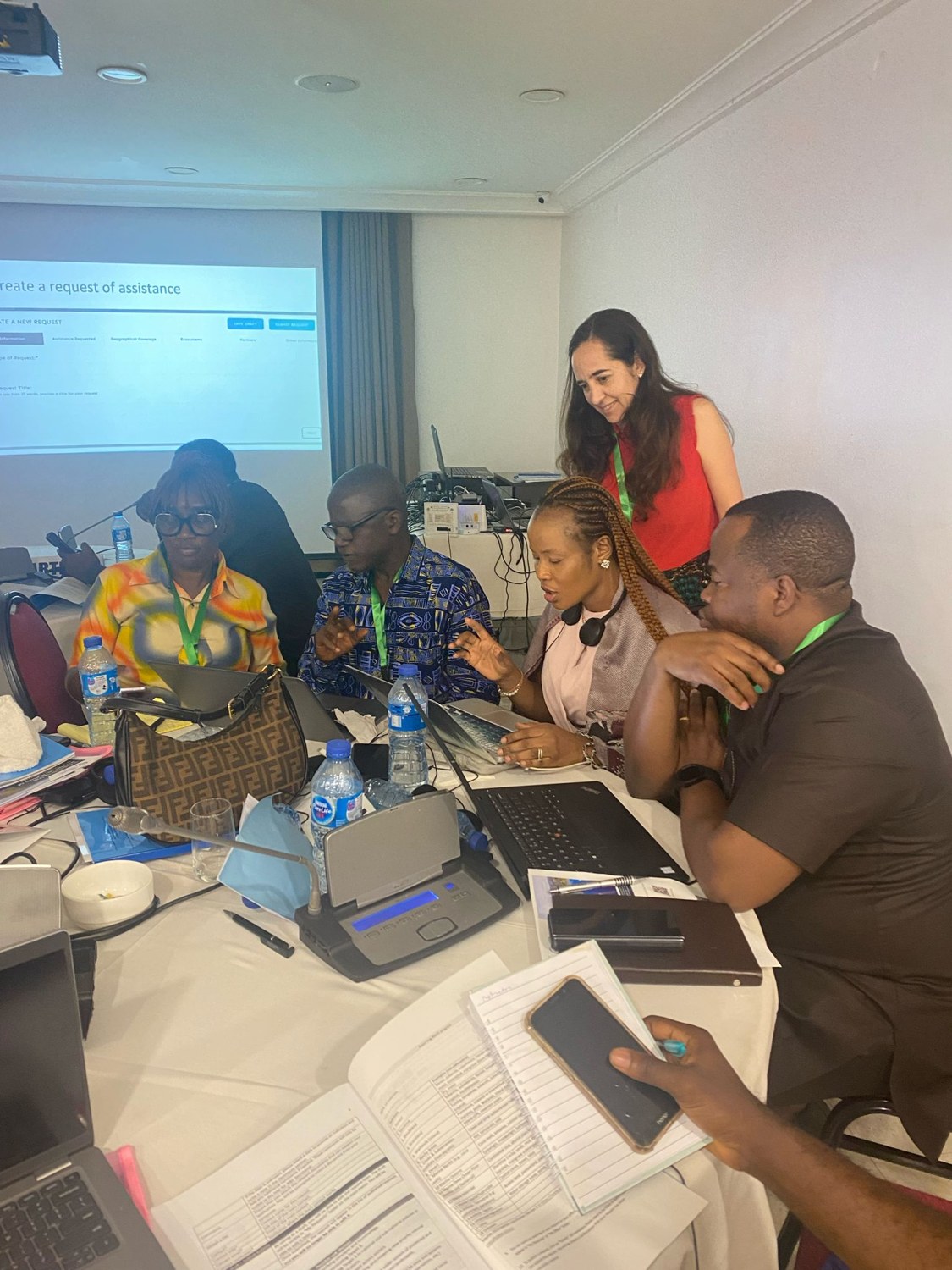
Participants working together around a table at the West Africa workshop in 2024.
West Africa workshop · 2024

HAC / West Africa

Connect priorities with practical assistance

Follow-up to the Abuja workshop included a match with Esri to support GIS licence donations, a training workshop and participation in West Africa 30x30 activities.

ICIMOD / South Asia

Strengthen cooperation on OECMs

Participants identified opportunities to document regional experience, build capacity, explore transboundary OECMs and strengthen the links between science, policy and practice.

SPREP / Pacific

Turn regional needs into support requests

SPREP reported support requests through the NBSAP Accelerator Partnership, alongside planned follow-up on management-effectiveness training and regional OECM guidance.

04 / The next phase

The workshop journey
continues.

Future exchanges can help countries share progress, revisit priorities and connect implementation needs with technical support, finance and peer experience.

01

Build from working models

Practical experience already exists across regions and governance systems.

02

Advance coverage and quality

Strengthen effectiveness, equity, connectivity and durability as conservation systems expand.

03

Invest in enabling conditions

Policy, finance, capacity, data and management reinforce one another.

04

Support country-led implementation

Use regional exchange to identify priorities and connect them with sustained, tailored support.

How workshop priorities become practical pathways

Participatory exercises facilitated by NatureXpairs helped translate collective discussions into region-specific priorities, technical assistance needs and potential actions. Outputs ranged from initial recommendations and cooperation proposals to more structured implementation pathways.

These outputs provide a foundation for cooperation and follow-up. They should be distinguished from formally adopted commitments or evidence that proposed actions have been implemented.

Annex 1 / Participant outputs

Explore the workshop
roadmaps.

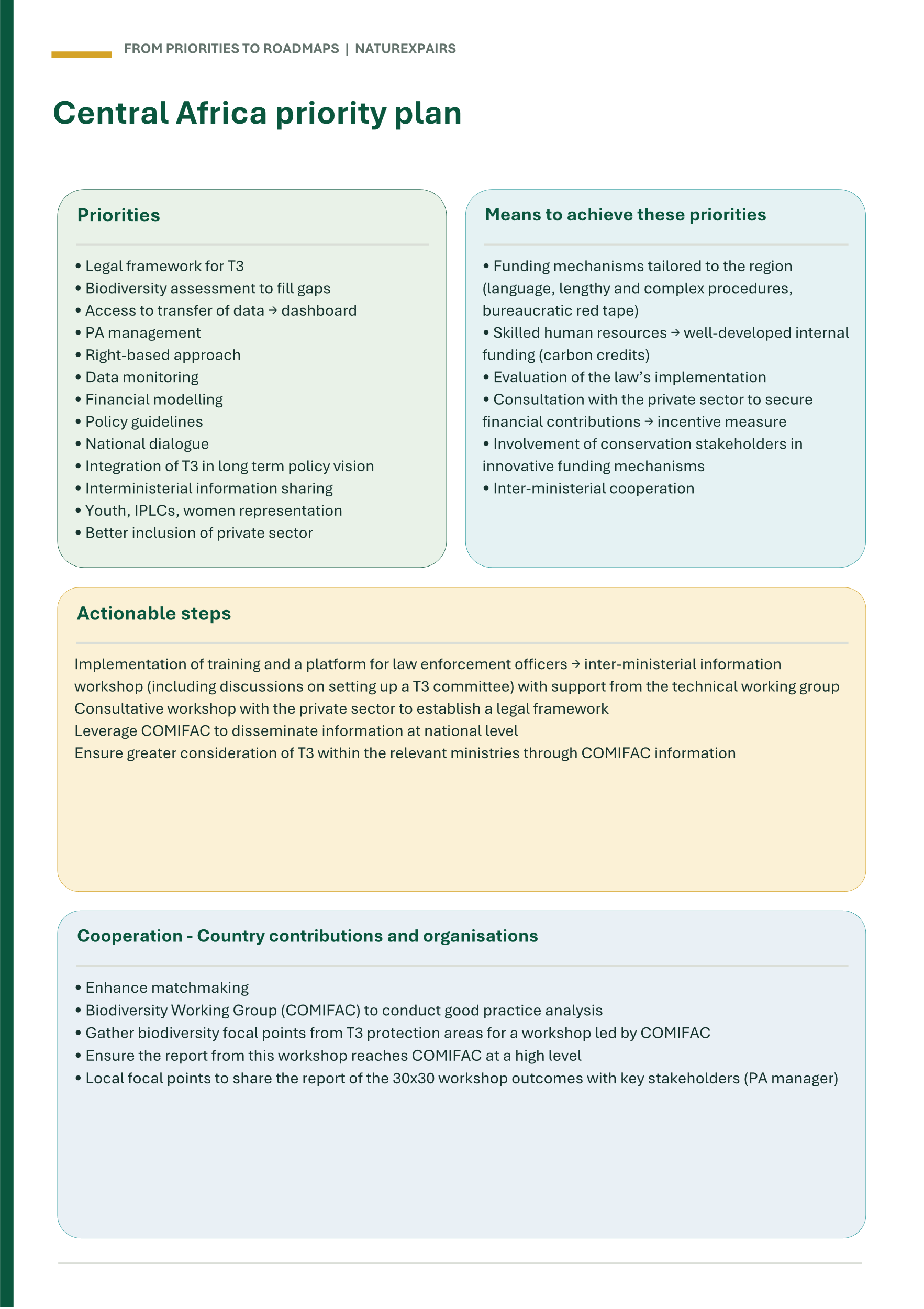
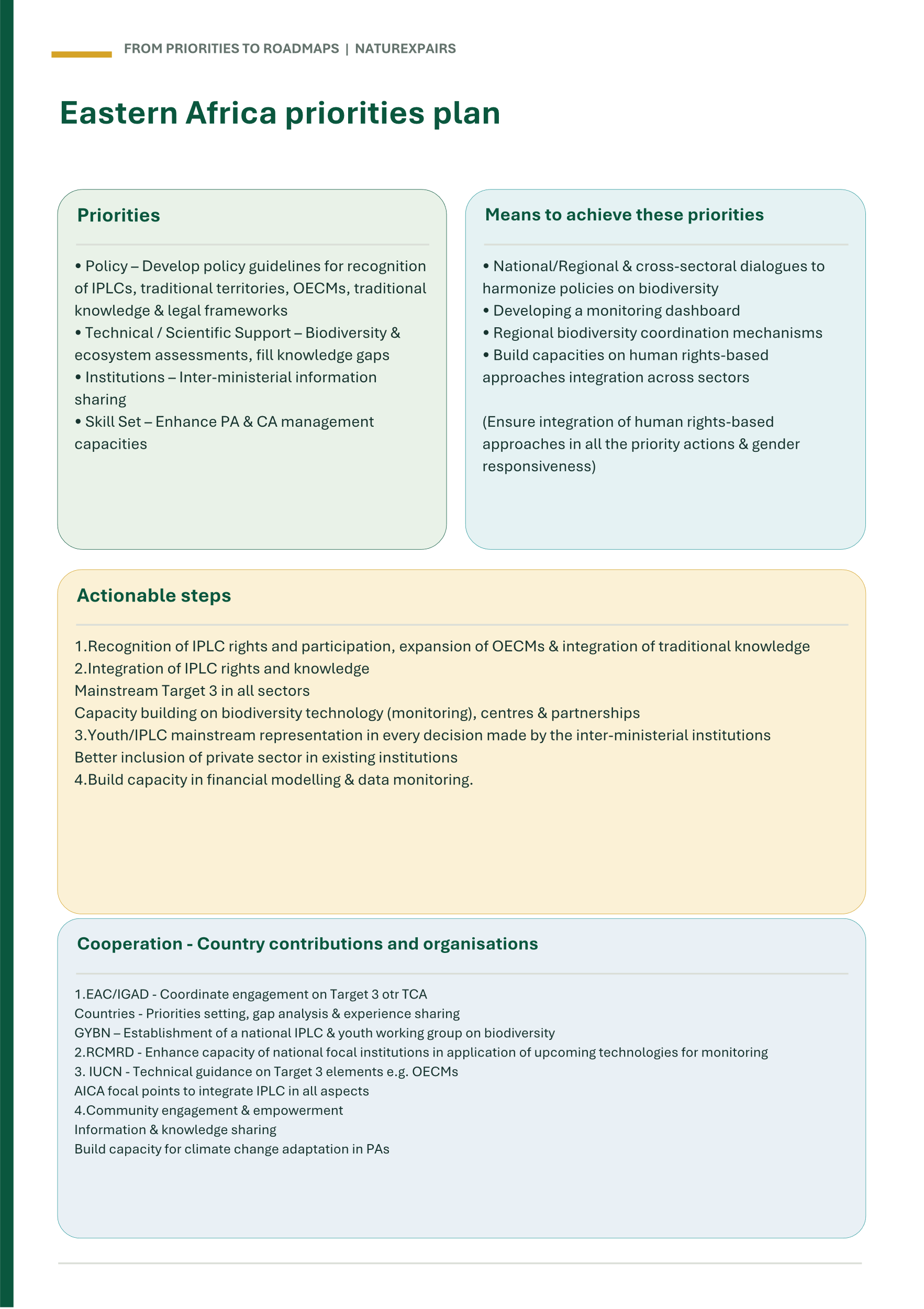
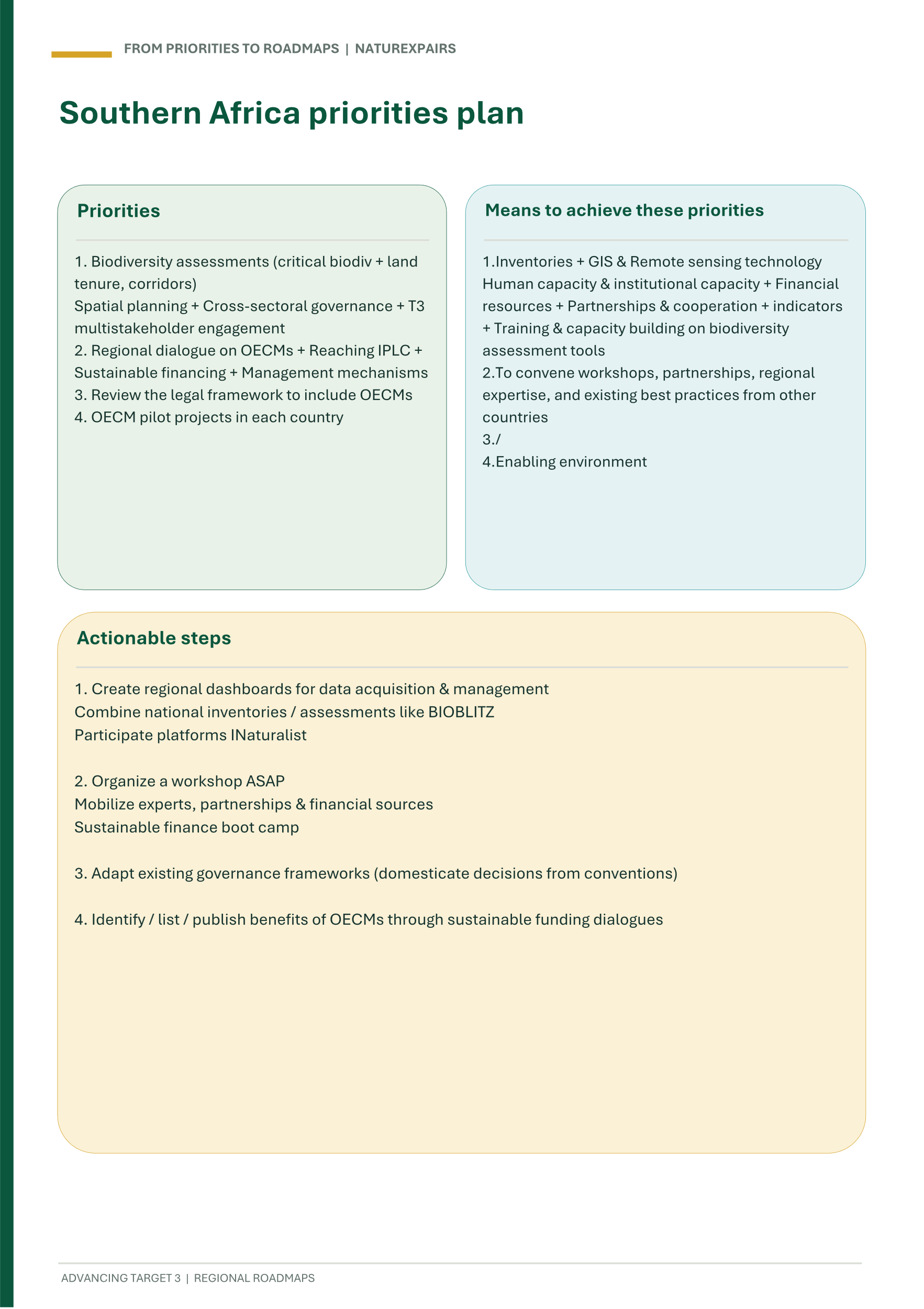
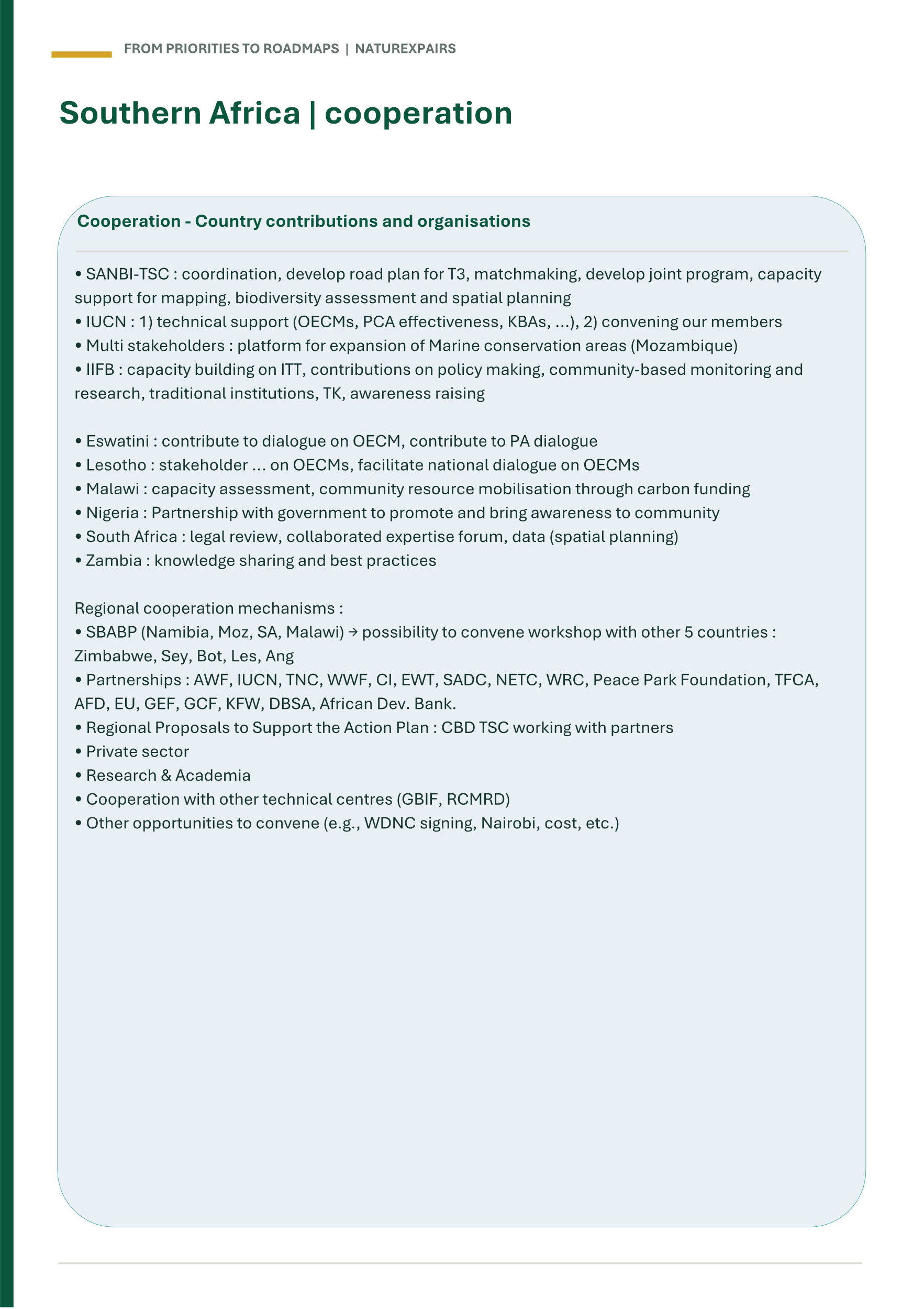
Open a region to view the original priorities, support needs and cooperation proposals developed through exercises facilitated by NatureXpairs.

Africa4 outputs
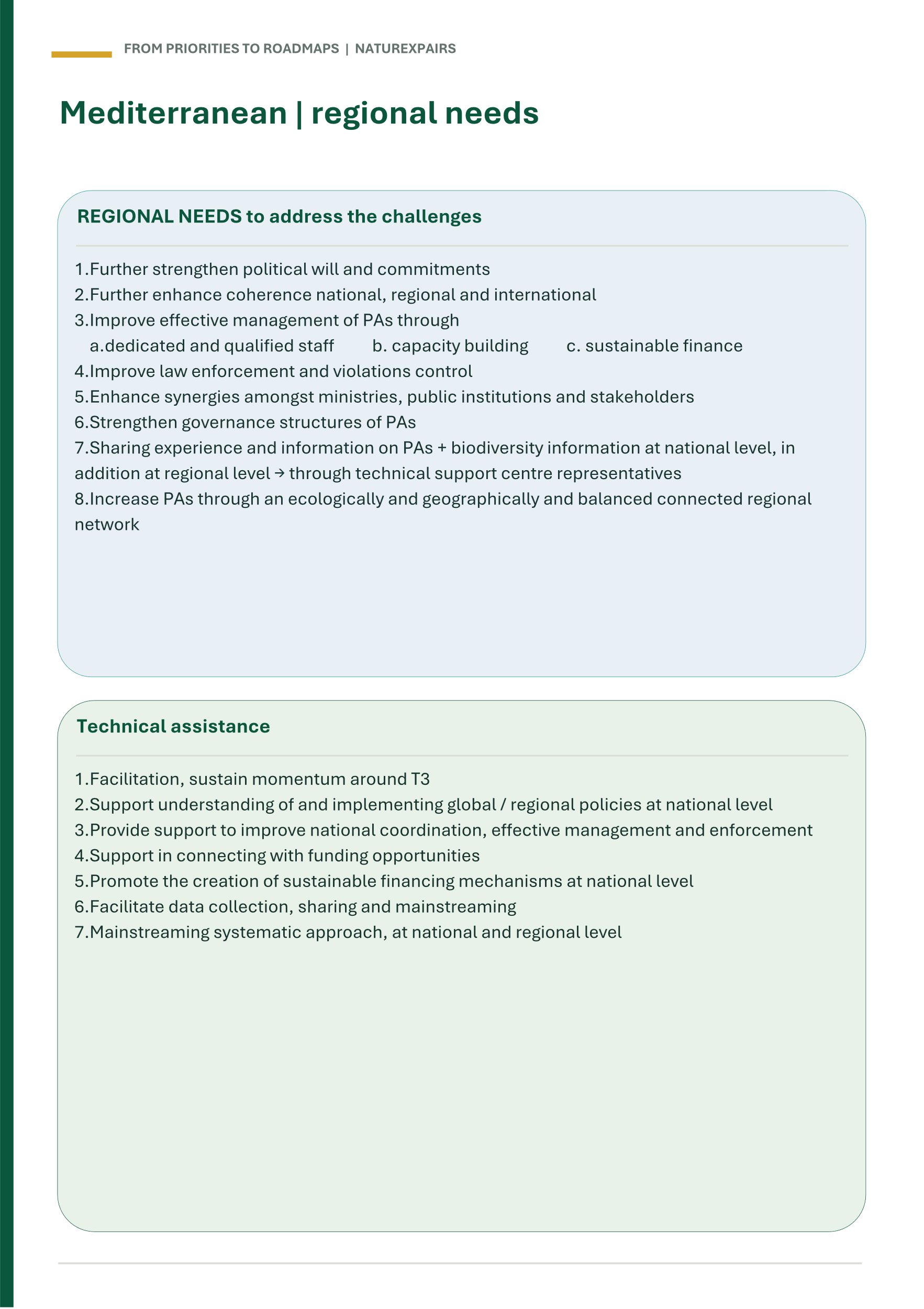
Mediterranean1 output
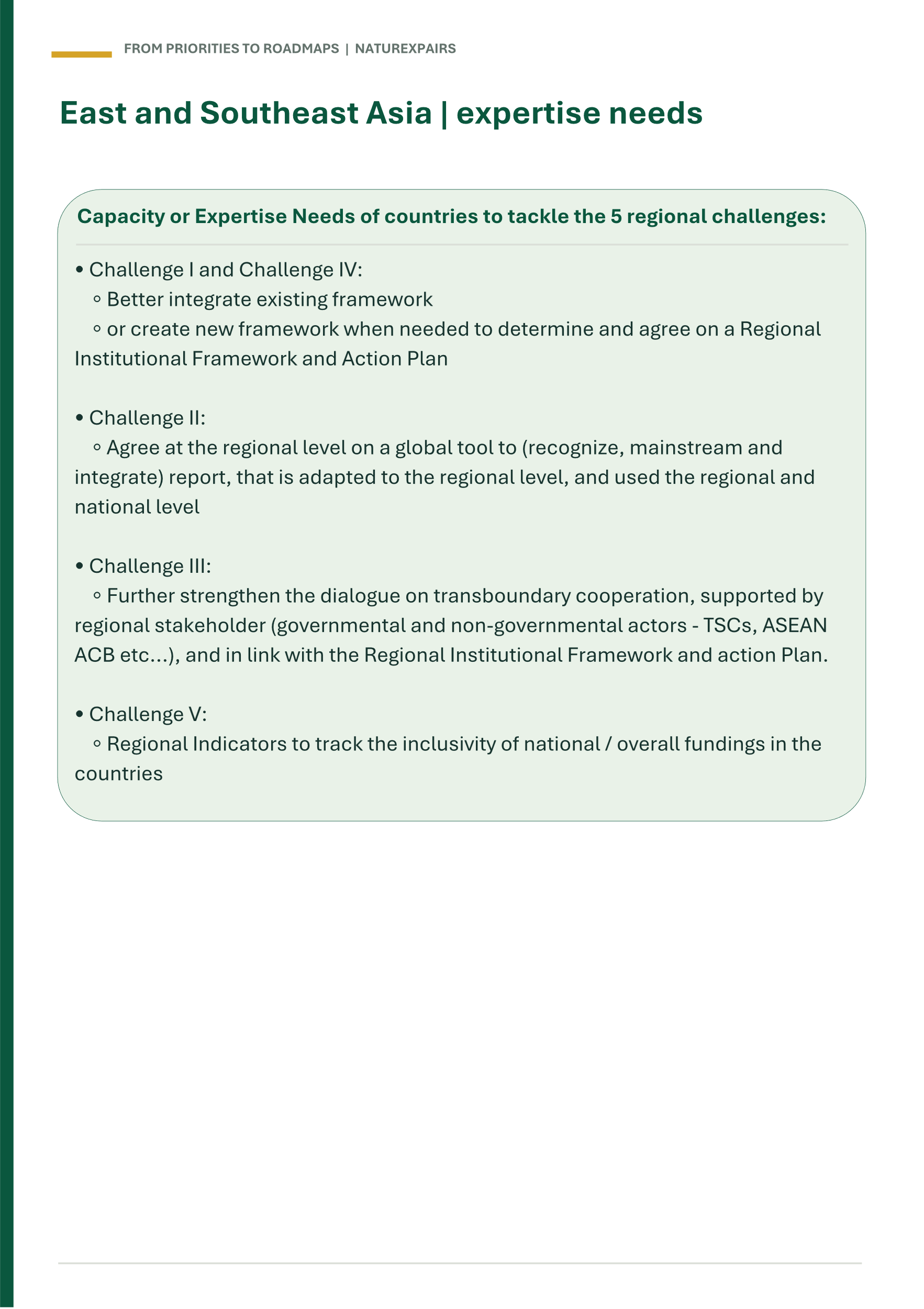
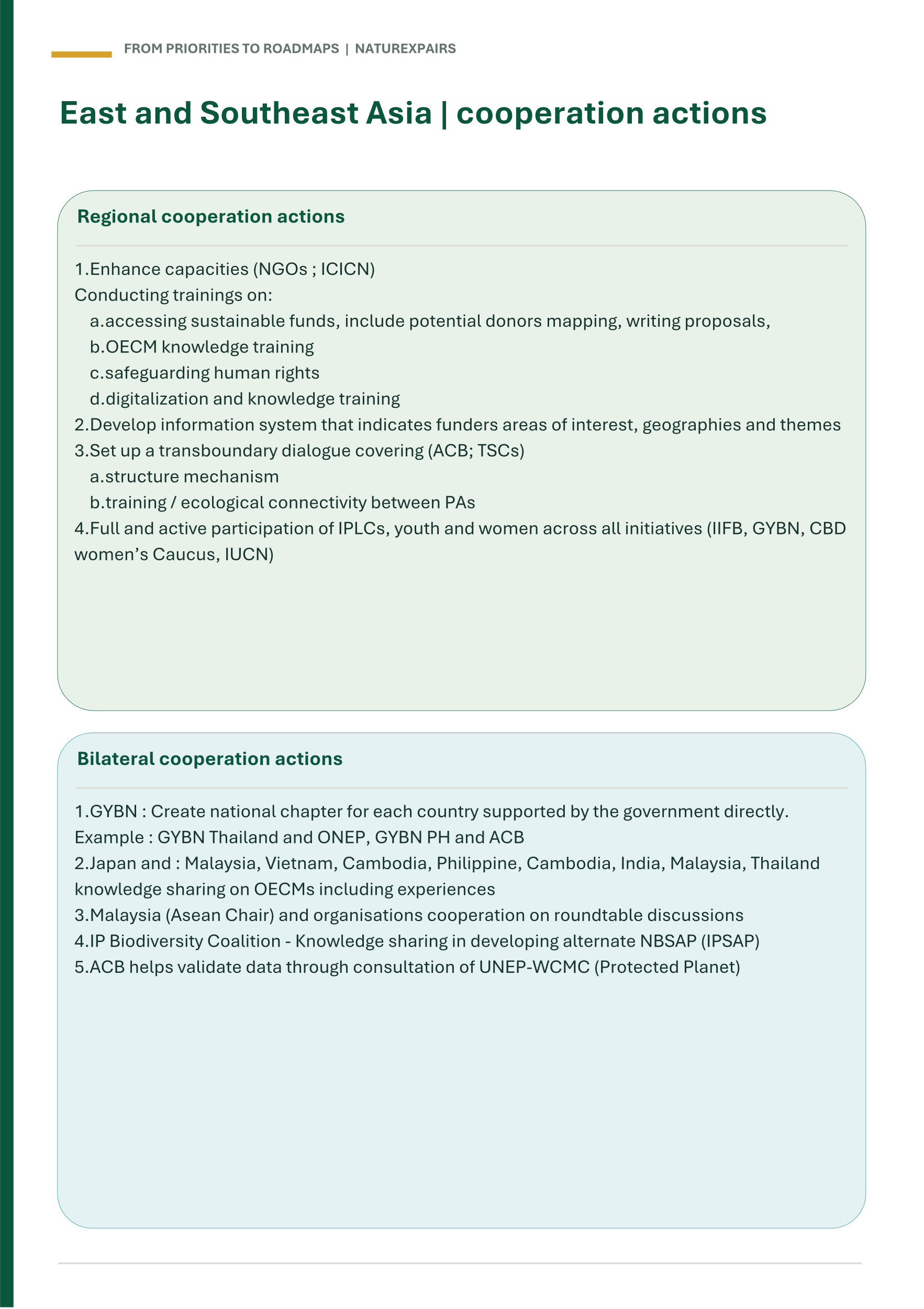
East and Southeast Asia2 outputs
East and Southeast Asia expertise needs, an original participant output from Annex 1.
East and Southeast Asia expertise needs
View full-size output (opens in a new tab)
East and Southeast Asia cooperation actions, an original participant output from Annex 1.
East and Southeast Asia cooperation actions
View full-size output (opens in a new tab)
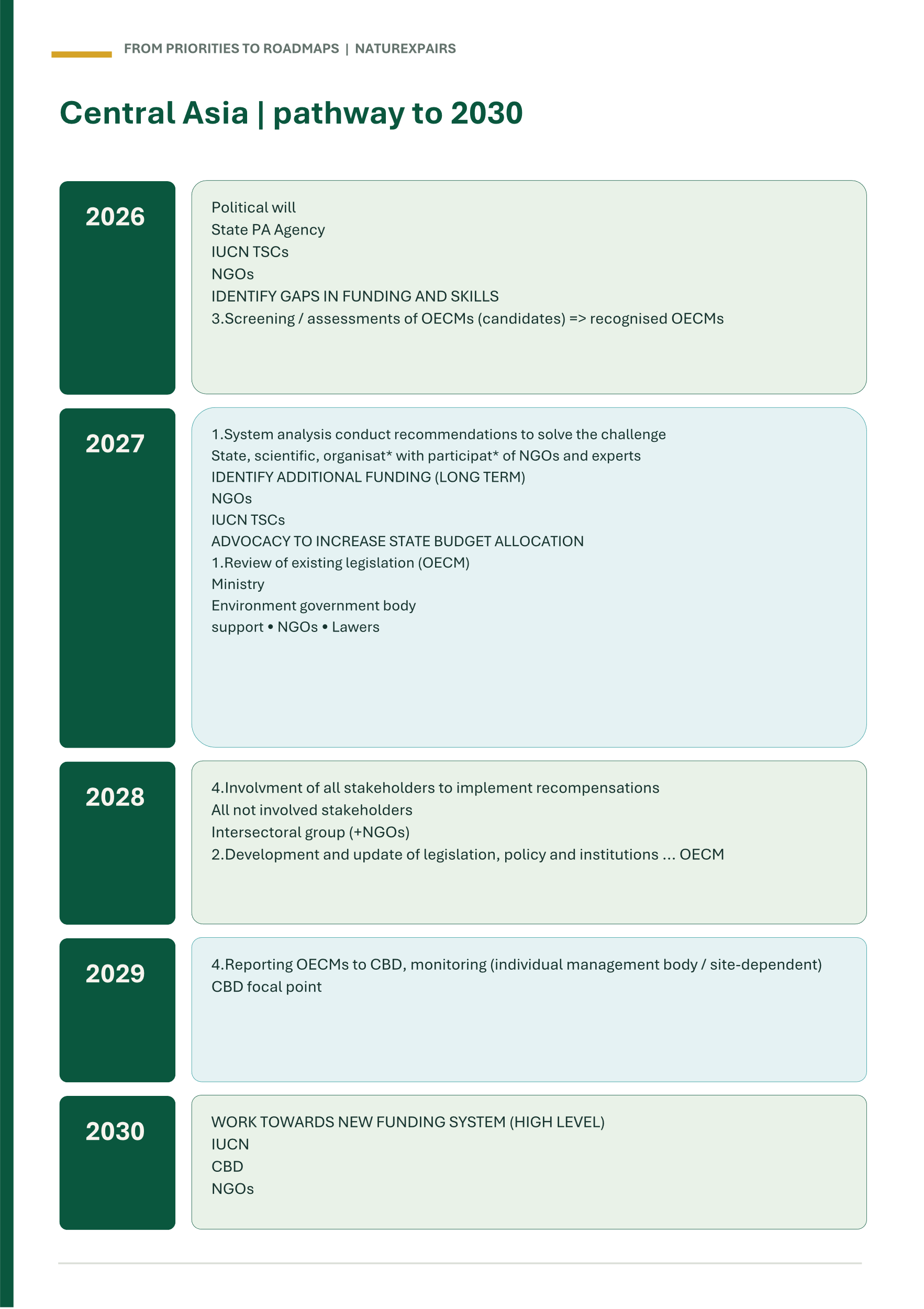
Central Asia1 output

These are outputs of workshop discussions, reproduced from the report annex. They do not necessarily represent formally adopted commitments or implementation plans.

Annex 2 / Geographic participation

Countries and territories
represented.

Explore participation across 12 regional and subregional Target 3 workshops, 2024–2026. Search by name or filter by workshop and year.

121Distinct countries and territories
147Country-workshop participations
709Participants across the series

Showing all 121 countries and territories

Download country list (CSV)
Country or territoryWorkshops attendedTotal
Albania
Mediterranean · Montpellier (2025)
1
Angola
Central Africa · Kinshasa (2024) Africa · Nairobi (2025)
2
Antigua and Barbuda
Caribbean · Georgetown (2024)
1
Argentina
Latin America · Costa Rica (2024)
1
Armenia
Central Asia · Tashkent (2026)
1
Australia
Pacific · Nadi (2024) Pacific · Sydney (2024) Pacific · Nadi (2026)
3
Azerbaijan
Central Asia · Tashkent (2026)
1
Bahamas
Caribbean · Georgetown (2024)
1
Bangladesh
South Asia · Kathmandu (2024)
1
Barbados
Caribbean · Georgetown (2024)
1
Belarus
Central Asia · Tashkent (2026)
1
Belize
Caribbean · Georgetown (2024)
1
Benin
West Africa · Abuja (2024)
1
Bhutan
South Asia · Kathmandu (2024)
1
Bosnia and Herzegovina
Mediterranean · Montpellier (2025)
1
Botswana
Africa · Nairobi (2025)
1
Brazil
Latin America · Costa Rica (2024)
1
Brunei Darussalam
Southeast Asia · Bangkok (2025)
1
Burundi
Central Africa · Kinshasa (2024) Africa · Nairobi (2025)
2
Cabo Verde
West Africa · Abuja (2024)
1
Cambodia
Southeast Asia · Bangkok (2025)
1
Cameroon
Central Africa · Kinshasa (2024) Africa · Nairobi (2025)
2
Central African Republic
Central Africa · Kinshasa (2024) Africa · Nairobi (2025)
2
Chad
Central Africa · Kinshasa (2024) Africa · Nairobi (2025)
2
Chile
Latin America · Costa Rica (2024)
1
Colombia
Latin America · Costa Rica (2024)
1
Comoros
Africa · Nairobi (2025)
1
Cook Islands
Pacific · Nadi (2024) Pacific · Nadi (2026)
2
Costa Rica
Latin America · Costa Rica (2024)
1
Cuba
Caribbean · Georgetown (2024)
1
Côte d’Ivoire
West Africa · Abuja (2024)
1
Democratic Republic of the Congo
Central Africa · Kinshasa (2024) Africa · Nairobi (2025)
2
Dominica
Caribbean · Georgetown (2024)
1
Dominican Republic
Caribbean · Georgetown (2024)
1
Egypt
Mediterranean · Montpellier (2025)
1
Equatorial Guinea
Central Africa · Kinshasa (2024) Africa · Nairobi (2025)
2
Eritrea
Africa · Nairobi (2025)
1
Eswatini
Africa · Nairobi (2025)
1
Ethiopia
Africa · Nairobi (2025)
1
Federated States of Micronesia
Pacific · Nadi (2024)
1
Fiji
Pacific · Nadi (2024) Pacific · Nadi (2026)
2
France
Mediterranean · Montpellier (2025)
1
Gabon
Central Africa · Kinshasa (2024) Africa · Nairobi (2025)
2
Gambia
West Africa · Abuja (2024)
1
Ghana
West Africa · Abuja (2024)
1
Grenada
Caribbean · Georgetown (2024)
1
Guatemala
Latin America · Costa Rica (2024)
1
Guinea-Bissau
West Africa · Abuja (2024)
1
Guyana
Caribbean · Georgetown (2024)
1
Honduras
Latin America · Costa Rica (2024)
1
India
South Asia · Kathmandu (2024)
1
Indonesia
Southeast Asia · Bangkok (2025)
1
Israel
Mediterranean · Montpellier (2025)
1
Jamaica
Caribbean · Georgetown (2024)
1
Japan
Southeast Asia · Bangkok (2025)
1
Kazakhstan
Central Asia · Tashkent (2026)
1
Kenya
Africa · Nairobi (2025)
1
Kiribati
Pacific · Nadi (2024) Pacific · Nadi (2026)
2
Kyrgyzstan
Central Asia · Tashkent (2026)
1
Lao People’s Democratic Republic
Southeast Asia · Bangkok (2025)
1
Lebanon
Mediterranean · Montpellier (2025)
1
Lesotho
Africa · Nairobi (2025)
1
Liberia
West Africa · Abuja (2024)
1
Madagascar
Africa · Nairobi (2025)
1
Malawi
Africa · Nairobi (2025)
1
Malaysia
Southeast Asia · Bangkok (2025)
1
Maldives
South Asia · Kathmandu (2024)
1
Marshall Islands
Pacific · Nadi (2024) Pacific · Nadi (2026)
2
Mauritius
Africa · Nairobi (2025)
1
Mexico
Latin America · Costa Rica (2024)
1
Mongolia
Southeast Asia · Bangkok (2025)
1
Montenegro
Mediterranean · Montpellier (2025)
1
Morocco
Mediterranean · Montpellier (2025)
1
Mozambique
Africa · Nairobi (2025)
1
Namibia
Africa · Nairobi (2025)
1
Nauru
Pacific · Nadi (2024)
1
Nepal
South Asia · Kathmandu (2024)
1
Nigeria
West Africa · Abuja (2024)
1
Niue
Pacific · Nadi (2024) Pacific · Sydney (2024) Pacific · Nadi (2026)
3
Pakistan
South Asia · Kathmandu (2024)
1
Palau
Pacific · Nadi (2024) Pacific · Sydney (2024) Pacific · Nadi (2026)
3
Panama
Latin America · Costa Rica (2024)
1
Papua New Guinea
Pacific · Nadi (2024) Pacific · Nadi (2026)
2
Paraguay
Latin America · Costa Rica (2024)
1
Peru
Latin America · Costa Rica (2024)
1
Philippines
Southeast Asia · Bangkok (2025)
1
Republic of Korea
Southeast Asia · Bangkok (2025)
1
Republic of the Congo
Central Africa · Kinshasa (2024) Africa · Nairobi (2025)
2
Russian Federation
Central Asia · Tashkent (2026)
1
Rwanda
Central Africa · Kinshasa (2024)
1
Saint Kitts and Nevis
Caribbean · Georgetown (2024)
1
Saint Lucia
Caribbean · Georgetown (2024)
1
Saint Vincent and the Grenadines
Caribbean · Georgetown (2024)
1
Samoa
Pacific · Nadi (2024) Pacific · Nadi (2026)
2
Senegal
West Africa · Abuja (2024)
1
Seychelles
Africa · Nairobi (2025)
1
Sierra Leone
West Africa · Abuja (2024)
1
Solomon Islands
Pacific · Nadi (2024) Pacific · Nadi (2026)
2
Somalia
Africa · Nairobi (2025)
1
South Africa
Africa · Nairobi (2025)
1
South Sudan
Africa · Nairobi (2025)
1
Spain
Mediterranean · Montpellier (2025)
1
Sri Lanka
South Asia · Kathmandu (2024)
1
Suriname
Caribbean · Georgetown (2024)
1
São Tomé and Príncipe
Central Africa · Kinshasa (2024) Africa · Nairobi (2025)
2
Tajikistan
Central Asia · Tashkent (2026)
1
Tanzania
Africa · Nairobi (2025)
1
Thailand
Southeast Asia · Bangkok (2025)
1
Togo
West Africa · Abuja (2024)
1
Tonga
Pacific · Nadi (2024) Pacific · Nadi (2026)
2
Trinidad and Tobago
Caribbean · Georgetown (2024)
1
Turkmenistan
Central Asia · Tashkent (2026)
1
Tuvalu
Pacific · Nadi (2024) Pacific · Nadi (2026)
2
Uganda
Africa · Nairobi (2025)
1
Uruguay
Latin America · Costa Rica (2024)
1
Uzbekistan
Central Asia · Tashkent (2026)
1
Vanuatu
Pacific · Nadi (2024) Pacific · Nadi (2026)
2
Venezuela
Latin America · Costa Rica (2024)
1
Vietnam
Southeast Asia · Bangkok (2025)
1
Zambia
Africa · Nairobi (2025)
1
Zimbabwe
Africa · Nairobi (2025)
1

05 / About the report

Learning grounded
in workshop evidence.

This digital edition presents the series, regional snapshots, shared findings and messages for the next phase.

Download the full report (PDF)

Digital preview · October 2026

Scope and methodology

The synthesis draws on available documentation from the 12 workshops, including country experiences, technical discussions, implementation challenges and recommendations.

  1. Review the evidence. Bring together experiences, priorities and practical approaches recorded during the workshops.
  2. Synthesize progress and priorities. Distinguish reported progress, remaining barriers and proposed actions while retaining regional context.
  3. Identify recurring conditions. Organize the findings around eight enabling conditions without treating regions as a ranking.
How to interpret the findings

Workshop documentation varies in detail, and not every country presentation was captured. This is a synthesis of available evidence, rather than a comprehensive assessment of national progress toward Target 3.

Recommendations and indicative roadmaps describe proposed pathways. They are not evidence that actions have subsequently been implemented.

Participants, partners and contributions

Participants included national government representatives, Indigenous Peoples and local communities, women’s and youth organizations, conservation organizations, technical experts and United Nations entities.

Conveners and contributors included the CBD Secretariat, HAC for Nature and People, IUCN and WCPA, NatureXpairs, the Office Français de la Biodiversité, host governments and regional institutions. Core organizing partners for each workshop are listed in the explorer.

Additional contributions came from ECOWAS, UNDP, Bloomberg Ocean Initiative, Blue Nature Alliance, Campaign for Nature, GIZ, the Congo Basin Forest Partnership, Pew, OFB, the French environment ministry, Pew Bertarelli Ocean Legacy, UNEP-WCMC, CIHEAM Montpellier and the Australian government. Roles and contributions varied by workshop.

Terms used in this report
OECMs
Other effective area-based conservation measures.
IPLCs
Indigenous Peoples and local communities.
NBSAPs
National biodiversity strategies and action plans.
PAME
Protected area management effectiveness.
Target 3
The area-based conservation target of the Kunming-Montreal Global Biodiversity Framework. The workshops considered both its coverage and qualitative elements.